(1).png "PowerHome.com")
Why DC-DC Isolation Matters
In many industrial and electronic systems, "getting the voltage conversion right" is only the first step. The true key to determining whether a system is stable, safe, and easy to maintain often lies in whether isolation is required between power domains. When your equipment connects simultaneously to sensors, communication interfaces, controllers, power modules, and even external devices or long-distance cables, numerous practical challenges arise: Potential differences between different grounds can cause ground loops; switching power supplies and motor-type loads generate significant electromagnetic interference (EMI); and common field environment hazards like surges, static electricity, and miswiring can subject the low-voltage control side to unexpected shocks. Without isolation between power input and output, noise and faults can propagate directly along the power path. Consequences range from measurement drift and unstable communication to control board burnout, and even electrical shock hazards and safety incidents.
Therefore, isolated DC-DC converters are ubiquitous in industrial automation, communication power supplies, medical electronics, automotive, and rail transit applications. Their value extends beyond merely "converting DC to another DC." By implementing electrical isolation, they establish safer, cleaner, and more controllable power boundaries between different modules. This separation isolates high-noise, high-risk sides from sensitive, low-power sides, enhancing system reliability while meeting stringent engineering safety and certification requirements.
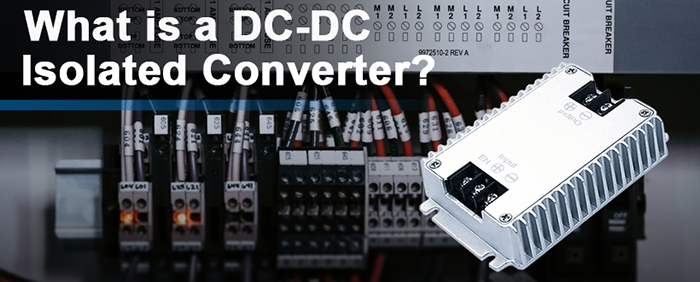
What Is a DC-DC Isolated Converter?
A DC-DC isolated converter is a type of power electronic device that converts one DC voltage level to another while providing galvanic isolation between the input and output. This means that there is no direct electrical connection between the input power source and the output load, allowing energy to be transferred magnetically, optically, or capacitively rather than through conductive paths.
The most common isolation method used in DC-DC converters is transformer-based magnetic isolation, where energy is transferred through a high-frequency transformer. In some specialized applications, optical or capacitive isolation methods may also be used to achieve similar safety and performance goals.
The primary functions of a DC-DC isolated converter include:
- Voltage regulation (step-up, step-down, or voltage inversion)
- Electrical isolation between different circuit domains
- Noise suppression and signal protection
- Improved system safety and reliability
Unlike non-isolated DC-DC converters, which share a common ground between input and output, isolated converters fully separate these grounds. This eliminates ground loops, minimizes electromagnetic interference (EMI), and significantly reduces the risk of damage caused by voltage transients, surges, or accidental short circuits. In addition, converter includes many more outstanding features in Powerhome.
In practical applications, DC-DC isolated converters are widely used in systems that involve high voltages, long-distance signal transmission, sensitive measurement electronics, or strict safety requirements, making them indispensable components in industrial and professional-grade electronic systems.
How Does a DC-DC Isolated Converter Work?

The working principle of a DC-DC isolated converter can be summarized in four main stages: DC-to-AC conversion, isolation, AC-to-DC rectification, and output regulation.
First, the input DC voltage is converted into a high-frequency AC signal using high-speed switching devices such as MOSFETs or IGBTs. This switching action is controlled by a pulse-width modulation (PWM) controller or a dedicated power management IC. By operating at high frequencies, the system can use compact transformers and achieve high power density.
Next, the high-frequency AC signal is transferred across an isolation transformer. This transformer provides complete galvanic isolation between the input and output sides, allowing energy to pass through magnetic coupling without any direct electrical connection. The turns ratio of the transformer determines whether the output voltage is stepped up, stepped down, or kept the same.
On the secondary side, the AC signal is then rectified back into DC using fast recovery diodes or synchronous rectification circuits. After rectification, filtering components such as inductors and capacitors smooth the output to produce a stable DC voltage.
Finally, a closed-loop feedback control system continuously monitors the output voltage and adjusts the switching behavior on the primary side to maintain precise voltage regulation under varying load and input conditions.
Through this process, a DC-DC isolated converter achieves efficient voltage transformation, strong electrical isolation, low output ripple, and high operational stability, ensuring reliable power delivery even in demanding industrial environments.
Isolated vs Non-Isolated DC-DC Converters
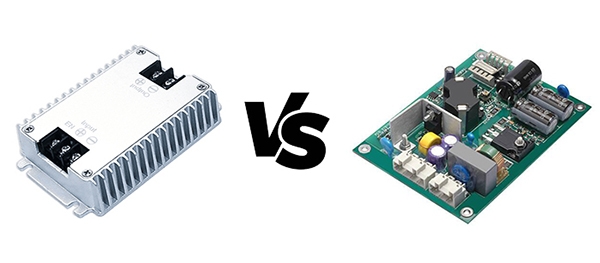
Non-isolated DC-DC converters typically feature simpler structures, lower costs, and potentially higher efficiency (in certain power ranges and topologies). They are suitable for systems with relatively single power domains, consistent ground references, and controllable risks—such as step-down power supplies within the same circuit board: converting 24V to 5V for logic chips, sharing input and output grounds, with short wiring and limited external interference. In such scenarios, non-isolated DC-DC converters are often the more economical choice.
The advantage of isolated DC-DC converters lies in addressing "system-level issues." Isolation significantly enhances system reliability when: - Inputs derive from noisy power buses (e.g., industrial 24V bus, automotive power, telecom room supply) - Outputs connect to sensitive loads or safety-critical components - Equipment requires cross-module or cross-chassis connections - Field conditions involve disparate grounding points or long cables causing ground potential differences Isolation reduces measurement errors and communication anomalies caused by ground loops, lowers the probability of direct surge or fault voltage propagation, and facilitates compliance with certain safety standards or isolation voltage requirements.
Of course, more isolation isn't always better. Isolated DC-DC converters typically entail higher BOM costs, more complex EMI mitigation, stricter insulation design requirements, and present thermal and layout challenges in compact, high-power-density applications. Therefore, a more reasonable engineering strategy is to isolate where necessary. For instance, employ isolated DC-DC converters for powering communication interfaces like RS485/CAN, sensor and analog front-end circuits, gate drivers, or high-side measurements. Conversely, use non-isolated DC-DC converters for standard logic power supplies within the same board that share a common ground reference, balancing cost and performance.
(1).png)


