(1).png "PowerHome.com")
In a complete photovoltaic power generation system, the PV combiner box plays an indispensable role. Whether it's a residential rooftop solar power station or a larger-scale commercial and industrial PV system, none can function without the combiner box's critical roles in power collection, protection, and monitoring. Many people, after purchasing PV modules, often focus their attention on connecting the inverter and electricity meter, while overlooking the proper connection method for the PV combiner box.
In reality, the correct installation steps for a high performance PV combiner box directly impact system operational safety and stability, while also determining the likelihood of future maintenance failures. Improper connections can result in reduced module power output at best, and at worst, cause dangerous DC arcing or short circuits. Therefore, understanding how to connect a PV combiner box is an essential skill for every professional and enthusiast in the field.
Understanding the Function and Structure
This blog begins with the structure of a PV combiner box, progressively explaining the wiring methods for PV arrays, the connection sequence of DC protection devices, and grounding approaches. Practical applications are used to illustrate how to avoid common mistakes. The core purpose of a PV combiner box is to aggregate the DC output from multiple PV array strings into one or more outputs, enabling stable transmission to the inverter. A standard combiner box typically includes these key components: DC circuit breakers, DC disconnect switches, surge protection modules, fuses, busbars, and monitoring modules. DC circuit breakers control branch circuit on/off states, surge protection modules absorb lightning pulse energy, fuses protect against branch overcurrent, and monitoring modules provide real-time current readings for each branch.
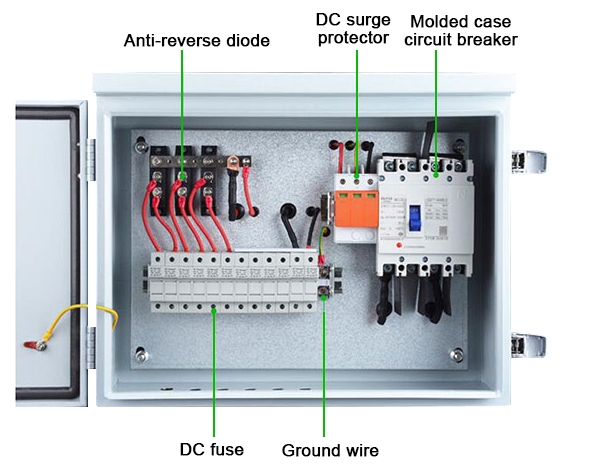
In practice, each string of modules typically generates the same voltage, but current varies with sunlight intensity and shading. The combiner box ensures that a single faulty string does not affect overall output through independent branch protection, while also enabling maintenance personnel to quickly locate the problematic string. Therefore, understanding the function of these components before beginning connections makes the wiring process more logical and allows you to accurately determine the necessity of each step.
Connecting PV Module Strings
Connection begins at the PV modules. Each string's output connects to the combiner box's branch input terminals via MC4 connectors. Before wiring, always verify that each string's open-circuit voltage falls within the combiner box's permissible range and ensure correct polarity. Generally, connect the module's positive terminal to the branch's “+” terminal and the negative terminal to the branch's “-” terminal. While seemingly straightforward, this step is one of the most common error points in the entire system. After all strings are connected, verify that the fuses match the short-circuit current of the modules and confirm the DC circuit breaker is in the off position. At this stage, all strings of the PV array have been distributed within the combiner box, preparing for the next step: connecting to the main circuit of the inverter.
PV Combiner Box Key Main Circuit
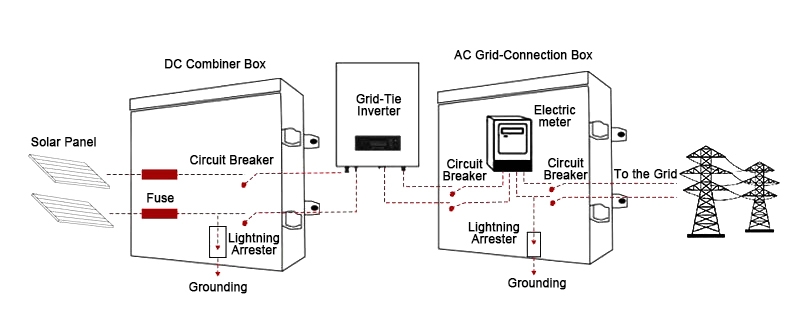
After completing the branch inputs, the next step is to connect the combiner box's main output terminals to the inverter's DC input terminals. The combiner box outputs typically feature thickened positive and negative terminals, requiring wiring with DC cables rated for the appropriate voltage level. Polarity must be verified before connection, as reverse polarity not only damages the inverter but may also cause an instantaneous system short circuit.
While connecting the main output, verify that the DC disconnect switch possesses sufficient breaking capacity and can reliably interrupt all current from the PV array during emergencies. Additionally, the grounding busbar of the surge arrester must be securely connected to the overall grounding system at this stage. This ensures rapid current dissipation to ground during lightning strikes or surges, safeguarding both the inverter and components.
In practical installations, selecting reliable photovoltaic combiner boxes and complementary power products is equally critical. PowerHome Online Shop is a specialized platform focused on off-grid living and solar solutions, offering a comprehensive range of photovoltaic products including PV combiner boxes, DC-DC converters, and different types of power inverters and other solar system accessories. For users seeking in-depth knowledge on combiner box selection, installation considerations, and system integration solutions, we provide systematic and engineering-oriented guidance to enhance understanding of the critical role combiner boxes play in photovoltaic systems.
Grounding, Monitoring, and Final Inspection
After completing the main circuit connections, grounding is an indispensable step. The lightning protection ground, metal enclosure ground, and monitoring module ground within the PV combiner box should all be uniformly connected to the system ground busbar, forming a low-resistance path. Subsequently, current monitoring modules can be configured according to project requirements to detect shading, mismatch, or localized damage by collecting branch-circuit current data in real time.
Final inspection includes: Verifying all screws are tightened, terminals are secure, disconnect switches operate freely, surge arrester indicator windows function normally, and enclosure seals remain intact. Before energizing, ensure the inverter is in standby mode. Then, sequentially engage the string circuit breakers and main circuit breaker before starting the inverter for self-testing.
While connecting a PV combiner box may appear as a simple wiring task, it actually encompasses multiple layers of functionality, including DC circuit protection, system safety design, and equipment lifespan management. Whether for PV contractors or DIY users, mastering the correct operational steps ensures more stable and reliable system operation. A properly installed PV combiner box effectively minimizes system downtime caused by branch circuit failures, reduces maintenance costs, and provides essential safety assurance for the long-term, efficient operation of inverters. Every step from understanding the internal structure of the PV combiner box to completing branch circuit grouping, main circuit wiring, and grounding configuration is critical.
(1).png)


