(1).png "PowerHome.com")
Power Divider

Coaxial Power Divider 2 Way, 0.5~8 GHz
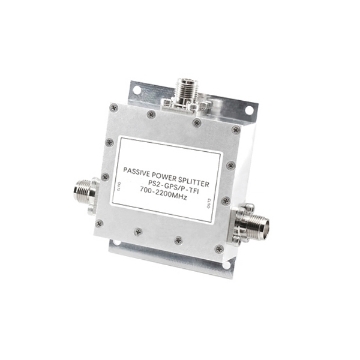
GPS Power Divider 2 Way, 0.7~2.2 GHz

Coaxial Power Divider 2 Way, 0.5~6 GHz

Coaxial Power Divider 2 Way,18~40 GHz

RF Power Divider 3 Way, 0.5~6 GHz

Coaxial Power Divider 4 Way, 0.5~6 GHz

GPS Power Divider 4 Way, 0.6~2.2 GHz

RF Power Divider 6 Way, 0.5~6 GHz

Microstrip Power Divider 8 Way, 0.5~6 GHz

Microstrip Power Divider 8 Way, 0.8~3 GHz

RF Power Divider 12 Way, 2~8 GHz

RF Power Divider 10 Way, DC~3 GHz

RF Power Divider 16 Way, 0.8~3 GHz

GPS Power Divider 32 Way, 0.8~2.7 GHz
A power divider, also known as an RF splitter or power splitter, is a passive component used in radio frequency (RF) and microwave systems to divide a single input signal into multiple output signals with equal (or sometimes unequal) amplitude and phase. It is a fully reciprocal device, meaning it can also function in reverse as a power combiner, merging multiple input signals into a single output. Power dividers are fundamental building blocks in modern communication systems, test equipment, GPS distribution networks, and antenna arrays, ensuring that high-frequency signals are distributed with minimal distortion, precise phase relationships, and consistent power levels across all paths.
Main Types of RF Power Dividers
-
Coaxial Power Dividers
Coaxial power dividers utilize precision machined air-dielectric or solid-dielectric transmission line structures within a cylindrical metal housing. They offer excellent wideband performance, high power handling, and superior shielding. Coaxial designs are preferred for laboratory test setups, high-power transmitters, and applications requiring robust mechanical construction. They are available in 2-way, 3-way, 4-way, and higher channel counts, with connector options including SMA, N-type, TNC, and 2.92mm for millimeter-wave frequencies. -
Microstrip Power Dividers
Microstrip power dividers are fabricated using printed circuit board (PCB) technology, where conductive traces are etched onto a dielectric substrate. They are planar, lightweight, and can be easily integrated into larger RF assemblies and MMIC designs. Microstrip dividers are ideal for compact systems, phased array antennas, and applications where size and weight are critical. They typically exhibit slightly higher insertion loss than coaxial designs but offer superior repeatability and low-cost manufacturing. -
GPS/GNSS Power Dividers
GPS power dividers are specialized components optimized for the 0.7-2.2 GHz frequency band used by global navigation satellite systems. They often incorporate additional features such as DC pass/DC injection capability, allowing bias voltage to be sent from the receiver to remote active antennas through the same coaxial cable. High-end GPS dividers may include integrated low-noise amplifiers (LNAs) and surge suppression to maintain signal integrity in large-scale timing and positioning networks. -
Wilkinson Power Dividers
The Wilkinson power divider is a specific circuit topology that achieves perfect isolation between output ports while maintaining matched conditions at all ports. It uses quarter-wave transformers and an internal isolation resistor. Wilkinson dividers are widely implemented in both coaxial and microstrip forms and are valued for their simplicity, excellent isolation, and low VSWR. -
Resistive Power Dividers
Resistive power dividers use purely resistive networks to split signals. They are extremely broadband, often operating from DC to many gigahertz, and provide excellent impedance matching. However, they introduce significant inherent loss (6 dB for a 2-way resistive splitter) and do not offer isolation between output ports. They are commonly used in low-power, broadband test applications where flat frequency response is paramount. -
Active Power Dividers
Active power dividers incorporate amplifier stages to compensate for splitter losses and boost signal levels. They are used in large-scale distribution systems, such as 16-way or 32-way GPS signal distribution, where passive splitter losses would be prohibitively high. Active dividers require DC power and offer features like gain control, equalization, and status monitoring.
Applications of Power Dividers
Wireless Communication Infrastructure
Power dividers are ubiquitous in cellular base stations, small cells, and distributed antenna systems (DAS). They distribute signals to multiple antennas for sectorized coverage and combine signals from multiple receivers. The wideband models (0.5-8 GHz) support 4G LTE, 5G NR, Wi-Fi, and private LTE networks simultaneously.
GPS and GNSS Timing Networks
In telecommunications and financial trading networks, precise timing is delivered via GPS signals distributed to hundreds or thousands of network elements. High-channel-count GPS power dividers (8-way, 16-way, 32-way) with DC injection capability enable centralized antenna architectures that reduce cost and simplify installation.
Phased Array and Radar Systems
Modern radar systems use phased array antennas with hundreds or thousands of individual radiating elements. Power dividers with exceptional phase and amplitude balance are essential for beamforming—the process of electronically steering the radar beam without moving parts. The 8-way and 12-way microstrip dividers are particularly suited for these applications.
Test and Measurement
In RF laboratories, power dividers are used to split reference signals to multiple instruments, create multi-channel test setups, and construct balanced measurement systems. Their precision, repeatability, and broadband nature make them indispensable tools for engineers.
Satellite Communications
From ground terminals to payload systems, power dividers manage signal distribution in both uplink and downlink paths. The ultra-wideband 40 GHz model supports emerging Ku-band and Ka-band satellite applications.
Aerospace and Defense
Military communication systems, electronic warfare suites, and airborne radars demand power dividers that operate reliably under extreme vibration, temperature, and altitude conditions. The rugged construction, wide temperature ratings, and high-quality connectors of PowerHome dividers meet these stringent requirements.
How to Select the Right Power Divider
- Define Your Frequency Requirements: Match the divider's frequency range to your system's operating band. Using a component outside its designed range will result in poor VSWR, high loss, and unpredictable phase behavior.
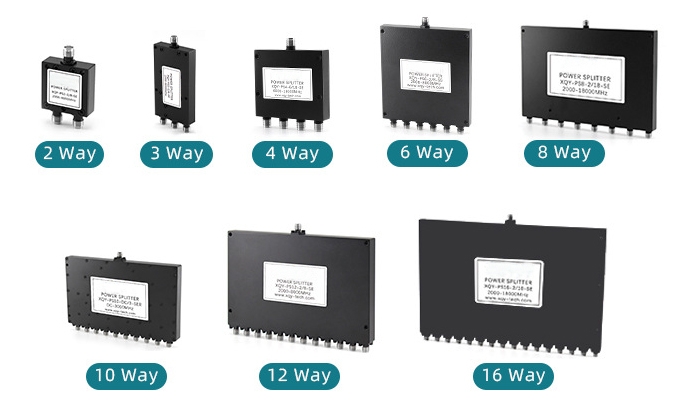
- Determine Channel Count: Choose the number of output ports required. Common configurations are 2-way, 3-way, 4-way, 6-way, 8-way, 10-way, 12-way, 16-way, and 32-way. Remember that each additional output introduces 3 dB of theoretical split loss.
- Evaluate Electrical Specifications: Prioritize specifications based on your application. Phased arrays require tight phase balance; high-dynamic-range receivers need high isolation; remote installations benefit from DC pass capability.
- Select Connector Type: SMA is the most common for general-purpose RF use up to 18 GHz. TNC offers better vibration resistance and weather sealing. 2.92mm (K) connectors are required for millimeter-wave frequencies above 26.5 GHz. N-type connectors handle higher power.
- Consider Power Handling: Ensure the divider's power rating exceeds your maximum transmit power. Remember that power combiners typically have lower power ratings than splitters.
- Assess Environmental Requirements: Verify operating temperature range, humidity resistance, and mechanical robustness for your deployment environment. Industrial and outdoor applications require components rated for extended temperature ranges (-40°C to +85°C).
- Physical Integration: Check dimensions, mounting options, and weight. For PCB integration, microstrip dividers offer surface-mount or connectorized planar packages. For rack systems, consider multi-channel chassis-mounted assemblies.
Power dividers are the silent workhorses of RF and microwave systems. At PowerHome, our comprehensive range of coaxial, microstrip, GPS-optimized, and ultra-wideband dividers delivers the precision, reliability, and performance that modern communication, defense, and test applications demand. Whether distributing GPS timing signals to an entire data center, feeding a phased array radar, or constructing a multi-channel 5G testbed, our power dividers provide the signal integrity foundation your system requires.
(1).png)
Strong Power Supply, Smart Power Solutions.


