(1).png "PowerHome.com")
Power Sequencer


8 Outlet Digital Power Sequencer for Audio


8 Outlet Power Sequencer with Remote, 6000W


10 Outlet Power Sequencer Controller, 5500W
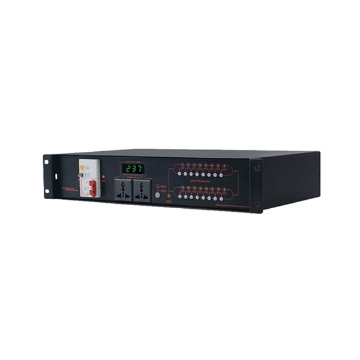


16 Outlet Power Sequencer Controller, WiFi-Enabled


16 Outlet Power Supply Sequencer, AC 240V


8U Rack Mount Power Sequencer, 7000W
A power sequencer is an intelligent power management device designed to control the order and timing of power delivery to multiple electronic systems. When several high-power devices are switched on simultaneously, the sudden surge of inrush current can trip circuit breakers, inject noise into sensitive audio signals, and gradually degrade internal components. A power sequencer eliminates these risks by introducing precise, timed delays between the activation of each connected outlet. This ensures that front-end equipment such as mixers, processors, or network switches are fully stabilized before high-current devices like power amplifiers or motors receive power. The reverse sequence during shutdown provides equal protection. Beyond basic sequencing, modern units offer remote WiFi control, real-time voltage monitoring, individual outlet switching, and integration with professional control systems—transforming passive power distribution into an active, protective layer for any professional installation.
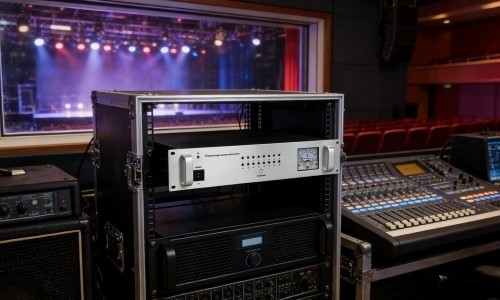
The Main Types of Power Sequencers
-
Basic Sequential Controllers
Fundamental sequencers focus on a single task: powering outlets on and off in a fixed order, typically with a 1 to 1.5-second delay per step. They rely on physical relays and simple logic circuits. These units are ideal for fixed installations where the sequence rarely changes, such as KTV booths, multimedia classrooms, and permanent stage setups. They provide essential surge protection at an accessible price point. -
Intelligent WiFi & Networked Sequencers
These models incorporate wireless modules (WiFi, RS232, RJ45) for remote access and automation. Users can control individual outlets, create custom power schedules, and monitor voltage from a computer or mobile device. They are essential for distributed systems, data centers, and smart buildings where centralized control over multiple sequencers is required. The integration capability allows them to be commanded by external control systems like Crestron or AMX. -
Rack-Mount & Form-Factor Specific Sequencers
Designed for spatial efficiency, these sequencers conform to standard 19-inch rack widths (1U to 8U heights). They often include space-saving features such as rear-panel outlets, horizontal mounting, and matching accessory racks. These are the preferred choice for broadcast vans, touring sound racks, and recording studios where every unit of rack space is valuable. -
Remote-Controlled Sequencers
Equipped with infrared or wired remote capabilities, these units allow operators to trigger power sequences from a distance. They are commonly used in environments where the sequencer is installed inside a closed cabinet or in an inaccessible location. The remote receiver is often detachable via an extension cable, ensuring line-of-sight is not an obstacle.
Working Principle of Power Sequencers
A power sequencer operates on a relatively simple but highly reliable electromechanical or solid-state principle. At its core is a timing control circuit that governs a series of relays—one for each output channel.
When the start command is initiated (either by a physical switch, remote signal, or network command), the control circuit energizes the first relay, powering outlet one. After a predetermined delay—commonly 1 second or 1.5 seconds—the circuit energizes the second relay, and so on, until all outlets in the sequence are active. The shutdown process reverses this order, de-energizing the last outlet first and working backward to the first.
In relay-based sequencers, high-quality power relays such as the JQX-105F-1 are used to handle substantial AC loads (up to 240V/30A). These relays provide physical isolation between the control logic and the high-power circuit, ensuring safety and durability. The relay contacts are typically made of silver alloy or cadmium-free materials to resist arcing and minimize contact resistance over thousands of switching cycles.
Intelligent sequencers incorporate a microcontroller that manages the timing logic. This allows the delay intervals to be software-adjustable, rather than fixed by hardware. The microcontroller also interprets commands from WiFi modules or serial interfaces, drives the status indicator LEDs, and samples the AC voltage via a small potential transformer to drive the digital display.
The memory function found in advanced models is achieved through non-volatile memory (EEPROM) that stores the last known state of the unit. In the event of a mains power failure and subsequent restoration, the microcontroller reads this memory to determine whether the sequencer should remain off or automatically restart the power-on sequence, preventing equipment from powering up unexpectedly.
Applications of Power Sequencers
-
Professional Audio & Live Performance: Powers mixing consoles and processors first, amplifiers last; eliminates speaker thump and protects drivers.
-
Broadcast & Recording Studios: Provides repeatable, controlled startup for racks of voltage-sensitive analog and digital gear.
-
Home Theater & High-End AV Systems: Enables one-touch power-up of projectors, screens, receivers, and gaming consoles in correct order.
-
Industrial Control & Server Rooms: Staggers startup of CNC machines, conveyor motors, and network servers to prevent breaker trips.
-
Commercial Installations: Manages distributed AV systems across bars, banquet halls, and houses of worship; supports daisy-chaining for large venues.
How to Choose the Right Power Sequencer
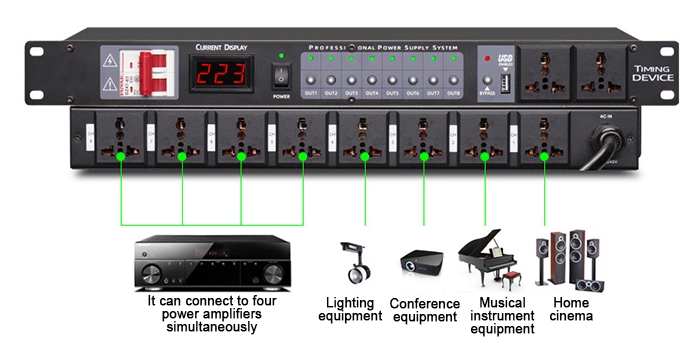
First, assess your load requirements and physical space. Count the number of devices that require sequencing and note their individual power consumption. Verify both the per-outlet and total system power ratings—high-power amplifiers or industrial motors may approach 2000W+ per channel. Ensure the sequencer’s input voltage range matches your local mains supply (110-120V, 220-240V, or universal 110-240V). Measure your available installation space; rack-mount units (1U to 8U) are standard for equipment racks, while desktop or portable models suit temporary setups.
Second, determine the necessary control method and features. For fixed installations with predictable sequences, a basic manual sequencer with fixed delays is sufficient and cost-effective. If the system requires remote operation, choose infrared models with extension cables for cabinet mounting. For centralized management across multiple zones or integration with building automation, select WiFi or network-enabled sequencers with RS232/RJ45 ports, individual outlet control, and software-adjustable timing.
Third, prioritize safety and long-term reliability. Look for units constructed with flame-retardant casings, UL-listed or RoHS-compliant internal components, and phosphor bronze sockets for corrosion resistance and stable conductivity. Consider models with memory function to maintain state after power outages. For mission-critical applications, verify the quality and rated cycle life of internal relays—professional-grade sequencers use high-current power relays rated for tens of thousands of operations.
(1).png)
Strong Power Supply, Smart Power Solutions.


