(1).png "PowerHome.com")
A DC-DC buck converter, also known as a step-down converter, is a power electronic device that efficiently reduces a higher DC input voltage to a lower, regulated DC output voltage. It is one of the most widely used voltage conversion circuits in modern electronics, playing a critical role in power management for consumer electronics, industrial systems, automotive applications, and embedded devices.
Purpose of a Buck Converter
Many electronic systems operate at lower voltages than their power sources provide. For example, a 12 V power supply may need to power a 5V microcontroller or a 3.3V sensor. A buck converter efficiently performs this voltage reduction while minimizing energy loss, unlike linear regulators that dissipate excess voltage as heat.
By using high-frequency switching and energy storage components, buck converters typically achieve efficiencies of 85-95% or higher, making them ideal for power-sensitive and high-current applications.
How a DC-DC Buck Converter Works
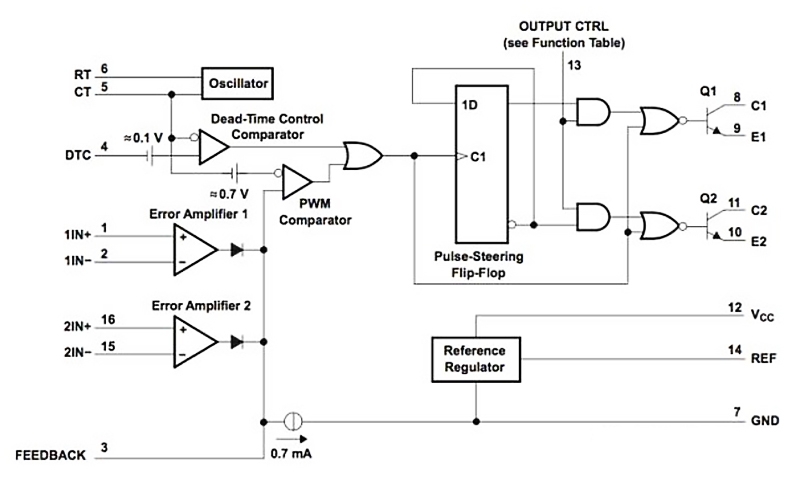
The operation of a buck converter can be explained through two repeating states:
1. Switch ON (Energy Transfer Phase)
When the switch turns on, current flows from the input source through the switch and inductor to the load. Energy is transferred directly to the output while the inductor stores energy in its magnetic field.
2. Switch OFF (Freewheeling Phase)
When the switch turns off, the inductor resists the sudden change in current and releases its stored energy. Current continues to flow through the diode or synchronous switch to the load, maintaining a stable output voltage.
The output voltage is controlled by the duty cycle, which is the ratio of ON time to the total switching period. In an ideal buck converter:
Vout = Vin × Duty Cycle
Main Components of a Buck Converter

A typical DC-DC buck converter is built from several key components that work together to efficiently step down voltage while maintaining stable output regulation. Each component has a distinct electrical role, and its selection directly affects efficiency, stability, and reliability.
- Switch (MOSFET): The switch is usually a power MOSFET controlled by the converter’s controller IC. It rapidly turns on and off at high frequency, controlling how much energy is transferred from the input to the output. The switching action determines the duty cycle, which directly sets the output voltage. High-quality MOSFETs with low on-resistance reduce conduction losses and improve overall efficiency, especially in high-current applications.
- Inductor: The inductor is the primary energy-storage element in a buck converter. When the MOSFET is on, the inductor stores energy in its magnetic field; when the MOSFET turns off, the inductor releases this energy to the load. The inductor also smooths current flow, preventing sudden changes that could cause instability or excessive ripple. Proper inductor value selection is critical for achieving low ripple current, fast transient response, and stable operation.
- Diode or Synchronous MOSFET: When the main switch turns off, current must continue flowing through the inductor. A diode (in asynchronous designs) or a second MOSFET (in synchronous designs) provides this current path. Traditional diodes are simple and robust but introduce forward voltage losses. Synchronous MOSFETs significantly reduce these losses, improving efficiency—especially at low output voltages and high currents.
- Output Capacitor: The output capacitor stores charge and filters the voltage delivered to the load. It works with the inductor to reduce voltage ripple and maintain a steady output during load changes. Low-ESR (Equivalent Series Resistance) capacitors are commonly used to minimize ripple voltage and improve transient response. In many designs, multiple capacitors are placed in parallel to enhance performance.
- Controller IC: The controller IC is the “brain” of the buck converter. It monitors output voltage (and often current and temperature), adjusts the switching frequency and duty cycle, and ensures stable regulation under varying input and load conditions. Modern controller ICs often integrate protection features such as overcurrent protection, thermal shutdown, soft start, and under-voltage lockout, greatly enhancing system reliability.
Buck Converter vs. Linear Regulator
One of the most common comparisons is between buck converters and linear regulators:
| Feature | Buck Converter | Linear Regulator |
| Efficiency | High (85-95%+) | Low when Vin ≫ Vout |
| Heat Generation | Low | High |
| Output Current | High | Limited |
| Complexity | Moderate | Simple |
| EMI Considerations | Yes | Minimal |
For low-power or noise-sensitive applications, linear regulators may still be used, but for most modern systems, buck converters are the preferred solution.
Applications of DC-DC Buck Converters
- Consumer Electronics: Smartphones, laptops, tablets, and gaming devices rely on multiple buck converters to power processors, displays, memory, and peripherals efficiently.
- Industrial Automation: PLCs, sensors, and control modules commonly step down 24 V industrial supplies to 12 V, 5 V, or 3.3 V rails.
- Automotive Electronics: Buck converters reduce 12 V or 48 V vehicle power to stable voltages for ECUs, infotainment systems, cameras, and sensors.
- Telecommunications and Networking: Routers, switches, and base stations use buck converters to supply high-current, low-voltage rails to digital ICs.
- Embedded Systems and IoT: Microcontrollers and wireless modules often rely on buck converters for efficient battery or adapter power conversion.
A DC-DC buck converter is an essential building block in modern electronic systems, providing an efficient and reliable way to reduce voltage while delivering high current and low power loss. SUCH provides DC DC converters with high efficiency, compact size, and versatile functionality, perfectly suited for electronics, industrial automation, automotive, and IoT systems.
(1).png)


