(1).png "PowerHome.com")
In modern electronic systems—from industrial automation equipment to new energy vehicles, from communication base stations to smart terminals—stable and efficient power conversion remains the foundation for reliable system operation. However, real-world power conditions are often far from ideal: Input voltage may fluctuate with load variations or fluctuate due to battery discharge, line losses, or operating mode changes.
Against this backdrop, the DC-DC boost-buck converter has emerged as an indispensable core component in power systems. It not only maintains stable output when input voltage exceeds or falls below the target voltage but also balances efficiency, size, and safety, delivering flexible and reliable power solutions for diverse electronic devices. Understanding how DC-DC boost-buck converters operate not only aids in engineering selection but also helps users maximize overall system performance.
Working Principle of DC-DC Boost-Buck Converters
From a functional perspective, DC-DC boost-buck converters typically leverage switching power supply technology. They achieve energy conversion through the coordinated operation of high-speed switching devices, energy storage components, and control circuits. The most common structural configurations include Buck-Boost, SEPIC, or four-switch synchronous topologies. Taking a typical buck-boost configuration as an example, the internal power switch rapidly switches on and off under the control of the driver IC. This transfers input electrical energy in pulsed form to the inductor for storage. The output is then filtered by a capacitor to deliver a smooth DC voltage. The control circuit continuously monitors input voltage, output voltage, and load current. Based on feedback signals, it dynamically adjusts the switching duty cycle to precisely regulate the output level. This closed-loop regulation mechanism enables the converter to respond rapidly to input voltage fluctuations while maintaining a stable output.
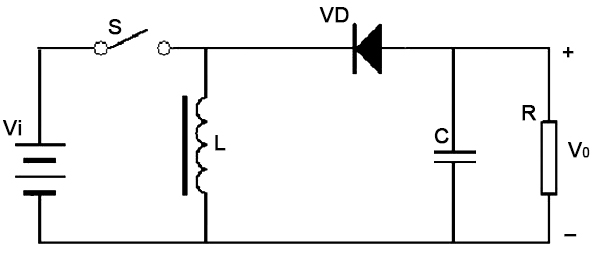
- The principle of step-up/step-down converters with opposite input/output polarities is illustrated in the figure.
- When the switch is closed, the inductor is energized by the input voltage (Vi), and the increase in magnetic flux is: (Vi) * Ton.
- When the switch is open, the inductor demagnetizes, and the decrease in magnetic flux is: (Vo) * Toff.
- When the states of switch closure and disconnection reach equilibrium, the increase in magnetic flux equals the decrease: (Vi) * Ton = (Vo) * Toff.
- Depending on the ratio of Ton to Toff, Vi may be less than Vo or greater than Vo.
In actual operation, boost and buck modes are not simple independent state switches but rather a continuous adjustment process. As the input voltage approaches the output setpoint, the converter smoothly transitions between operating modes to prevent output ripple or efficiency drops. This is particularly critical for high-precision electronic equipment, where instantaneous voltage fluctuations can trigger system malfunctions or even damage components. Concurrently, modern high-performance DC-DC step-up/step-down converters widely incorporate technologies like synchronous rectification, soft-start, and overvoltage/overcurrent protection, delivering superior efficiency, safety, and longevity compared to earlier designs.
Advantages of DC-DC Boost-Buck Converters
A DC-DC boost-buck converter is a DC voltage conversion device capable of both boosting and buck conversion. Compared to traditional DC-DC modules that can only boost or buck in one direction, this type of converter offers greater adaptability across a wider range of input voltages. When the input voltage exceeds the target output voltage, it operates in buck mode. When the input voltage falls below the target value, it automatically switches to boost mode. This capability makes it particularly suitable for scenarios with wide input voltage variations, such as battery-powered systems, automotive power supplies, or distributed power networks. Its core value lies not merely in “voltage conversion,” but in delivering continuous, stable, and controllable DC output to the load under complex power conditions.
Applications of DC-DC Boost-Buck Converters
At the application level, DC-DC boost-buck converters find extremely broad usage scenarios. In battery-powered systems, they address the issue of fluctuating battery voltage as charge levels decrease, ensuring a stable power supply throughout the entire discharge cycle. In new energy vehicles and automotive electronics, where multiple voltage levels coexist, these converters enable efficient switching between 12V, 24V, and even higher voltages, delivering reliable power to onboard control units, sensors, and infotainment systems. Within industrial automation and communication equipment, they adapt unstable field power sources or long-distance supply lines, minimizing the impact of voltage fluctuations on system precision and stability.
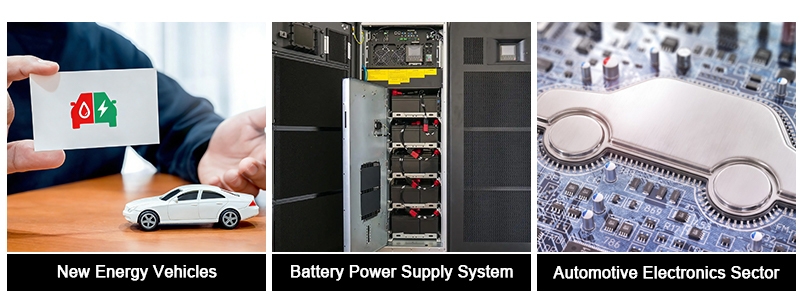
Additionally, DC-DC step-up and step-down converters play a critical role in new energy and distributed energy systems. For instance, in photovoltaic or energy storage systems, the DC bus voltage fluctuates with changes in sunlight conditions and load. Step-up and step-down converters enable voltage matching between different modules, enhancing overall energy utilization efficiency. In portable electronics and IoT devices, these converters deliver high-efficiency power management within limited space, extending device runtime. PowerHome.com offers multiple models of DC-DC step-up/step-down converters featuring wide input voltage ranges, high efficiency, and stable output performance. Suitable for industrial equipment, new energy systems, and automotive applications, they support customized power solutions.
DC-DC boost-buck converters are not merely single-function power modules but serve as critical bridges connecting input energy sources to end loads. Through flexible operating modes and precise control mechanisms, they resolve practical challenges such as voltage instability and complex power supply conditions. As electronic systems demand ever-greater stability and energy efficiency, the importance of these converters will only grow. Looking ahead, as application scenarios continue to expand and technology advances, DC-DC converters will play a foundational and profound role across more domains, becoming indispensable core components in modern electronic systems.
(1).png)


