(1).png "PowerHome.com")
Voltage Stabilizer


30 kVA Automatic Voltage Stabilizer, Single Phase, 110V~240V


200 kVA Automatic Voltage Stabilizer, Three Phase, 400V/415V/440V


40 kVA Automatic Voltage Stabilizer, Single Phase, 110V~240V


250 kVA Automatic Voltage Stabilizer, Three Phase, 220V/380V/440V


50 kVA Automatic Voltage Stabilizer, Single Phase, 110V~240V


300 kVA Automatic Voltage Stabilizer, Three Phase, 208V/380V/480V
What Is a Voltage Stabilizer?
A voltage stabilizer, also called an automatic voltage regulator (AVR) or AC voltage conditioner, is a power supply device that continuously monitors incoming mains voltage and automatically corrects any deviation to maintain a stable, preset output voltage. Whether the grid supplies too little or too much voltage, the stabilizer compensates in real time, ensuring your connected equipment always receives clean, consistent power.
Modern grids are far from perfect. Load shedding, long distribution lines, heavy industrial neighbors, and weather events can push supply voltage above or below its rated level by 20% or more. Over time, under-voltage causes motors to overheat and draw excess current, while over-voltage stresses insulation and shortens component lifespans. A quality voltage stabilizer eliminates these risks.
PowerHome voltage stabilizers are built on two proven topologies: relay switching for cost-effective, fast-response domestic applications, and servo-motor compensation for high-precision industrial loads. Both types feature automatic operation — no manual intervention required once set up.
How Does a Voltage Stabilizer Work?
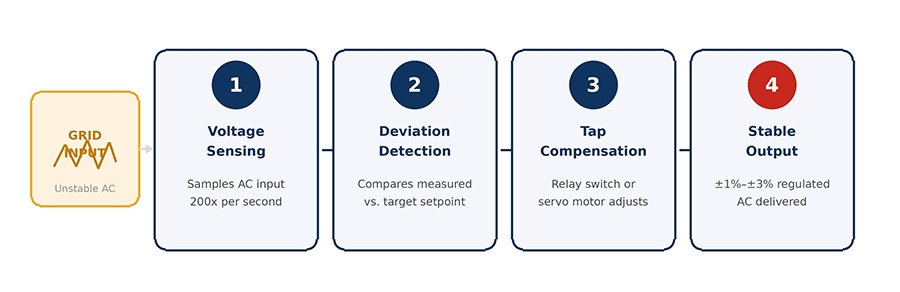
Every stabilizer follows the same fundamental four-stage operating cycle to deliver regulated power to your load:
- Voltage Sensing: An internal sampling circuit continuously measures the incoming AC supply voltage hundreds of times per second.
- Deviation Detection: The intelligent CPU or control circuit compares the measured value against the preset output target and calculates the required correction.
- Compensation: For relay types, the CPU instantly switches transformer taps. For servo types, a motor rotates a carbon brush along a toroidal autotransformer for stepless, continuous adjustment.
- Stable Output: Regulated voltage — 110 V, 220 V, 380 V, or a custom level — is delivered to the load with ±1%–±3% accuracy, regardless of input fluctuation.
Our Voltage Stabilizer Product Lines
PowerHome offers single-phase and three-phase voltage stabilizers across its full product range, covering applications from residential to heavy industrial.
I. Single-phase stabilizer for residential & small commercial
- Designed for single-phase 110 V or 220 V supply systems
- Capacities from 500 VA to 30 kVA
- Perfect for protecting individual household appliances or small office networks
- Lightweight, wall-mountable, or floor-standing options
- Turn-on delay protects connected devices during grid restoration
Popular Models: 500 VA, 1 kVA, 2 kVA, 3 kVA, 5 kVA, 8 kVA, 10 kVA, 12 kVA, 15 kVA, 20 kVA, 30 kVA
II. Three-phase stabilizer for industrial & heavy commercial
- Three-phase 4-wire system (3P+N) for balanced industrial loads
- Default 380V output; 415V/480V or more versions available
- Capacities from 8 kVA to 150 kVA; larger custom units on request
- Air-cooled enclosures for continuous 24/7 industrial operation
- Built-in protection: over/under voltage, over-temp, overload, short-circuit
Popular Models: 8 kVA, 15 kVA, 20 kVA, 30 kVA, 40 kVA, 50 kVA, 60 kVA, 80 kVA, 100 kVA, 150 kVA
Application Scenarios
Wherever voltage instability threatens equipment performance or longevity, PowerHome stabilizers deliver the protection needed. Our product line covers every scale of application:
- Residential & Home Use: Protect refrigerators, air conditioners, washing machines, flat-screen TVs, computers, and home theater systems from the damaging effects of voltage sags and surges. Models from 500 VA to 5 kVA are ideal for individual rooms or whole-home coverage.
- Office & Commercial Buildings: Server rooms, POS terminals, printers, and telecommunications equipment demand stable power. Single-phase 5–30 kVA units protect entire office floors, while three-phase models handle commercial HVAC and elevator systems.
- Industrial Manufacturing: CNC machines, robotic arms, variable-frequency drives (VFDs), and PLCs require tight voltage tolerance to prevent erratic behavior and premature failure. Three-phase servo stabilizers (30–150 kVA) deliver the ±1% accuracy these systems demand.
- Laboratories & Medical Facilities: Analytical instruments, imaging equipment (MRI, CT), and precision testing devices are extremely voltage-sensitive. High-accuracy servo models ensure readings remain reliable and equipment warranties remain valid.
- Telecommunications & Broadcasting: Telecom base stations, broadcasting transmitters, and data center infrastructure cannot tolerate voltage anomalies. Our industrial stabilizers with continuous 24/7 rated operation keep uptime guarantees intact.
- Agriculture & Rural Areas: Remote grid connections often suffer the most severe voltage fluctuations. Irrigation pumps, cold storage units, and processing equipment benefit greatly from wide-input-range stabilizers designed to cope with chronic undervoltage conditions.
How to Choose the Right Voltage Stabilizer?
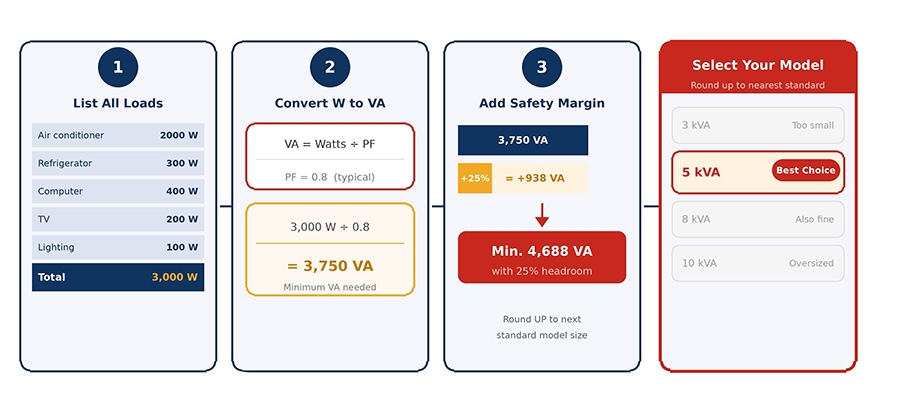
Selecting the correct stabilizer is critical for optimal protection and value. Follow these five steps to find the ideal unit for your application:
- Measure Your Load (Calculate Required kVA): Add up the rated wattage (W) or volt-ampere (VA) rating of all devices to be connected. Divide total watts by the power factor (typically 0.8) to get VA, then add a 20–30% safety margin. For example, 3000W ÷ 0.8 = 3750VA → select a 5 kVA stabilizer.
- Determine Your Phase Requirement: Single-phase stabilizers suit residential loads and small commercial equipment running on 110 V or 220 V. Three-phase units are required for industrial machinery, large HVAC systems, and any equipment wired for 380V/415V/480V three-phase supply.
- Know Your Input Voltage Range: Measure actual voltage at your supply point during peak and off-peak hours. Ensure the stabilizer's input range comfortably brackets both extremes. For heavily fluctuating rural grids, prioritize units with ±20% or wider input tolerance.
- Choose the Regulation Type: Relay-type stabilizers offer fast, economical protection for standard household and commercial loads. Servo-motor types are recommended for precision equipment such as CNC machines, medical instruments, and variable-frequency drives where tighter output accuracy (±1%) is required, and instantaneous step switching is unacceptable.
- Verify Environmental & Installation Requirements: Consider ambient temperature, humidity, and dust levels. Industrial sites should select IP24-rated or higher enclosures. Ensure adequate ventilation clearance (typically 20 cm on all sides) and check that the unit's physical dimensions fit the planned installation space.
Installation & Safety Notes
Proper installation is as important as selecting the right unit. Keep the following guidelines in mind:
- Location: Install the stabilizer in a clean, dry, well-ventilated area. Maintain at least 20 cm clearance on all sides for airflow. Avoid direct sunlight, chemical fumes, and vibration-prone surfaces.
- Wiring: Use cable rated for at least 125% of the stabilizer's maximum input current. Ensure the upstream circuit breaker rating matches the manufacturer's recommendation. Always connect the chassis earth terminal to a reliable protective earth (PE) conductor.
- Power-on sequence: Switch on the stabilizer first, allow the output to stabilize (observe the LED display), then power on connected loads. This prevents inrush current stacking that could trigger the over-current protection.
- Maintenance: Clean the ventilation grilles every 6 months. For servo-type units, inspect carbon brushes annually and replace when worn to within 5 mm of the brush holder. Never operate the unit with panels removed.
(1).png)
Strong Power Supply, Smart Power Solutions.


