(1).png "PowerHome.com")
Hybrid Inverter

1kW WiFi Dual Output Hybrid Inverter


2.5kW Single Phase Hybrid Inverter


3kW WiFi Dual Output Hybrid Inverter


3.6kW 48V Hybrid Inverter


4kW WiFi Dual Output Hybrid Inverter

5kW WiFi Dual Output Hybrid Inverter


6kW WiFi Dual Output Hybrid Inverter


6.2kW Off Grid Hybrid Inverter


6.5kW 48V Hybrid Inverter


7kW Split Phase Hybrid Inverter


8kW WiFi Dual Output Hybrid Inverter


10kW WiFi Dual Output Hybrid Inverter

11kW WiFi Dual Output Hybrid Inverter


12kW Off Grid Hybrid Inverter
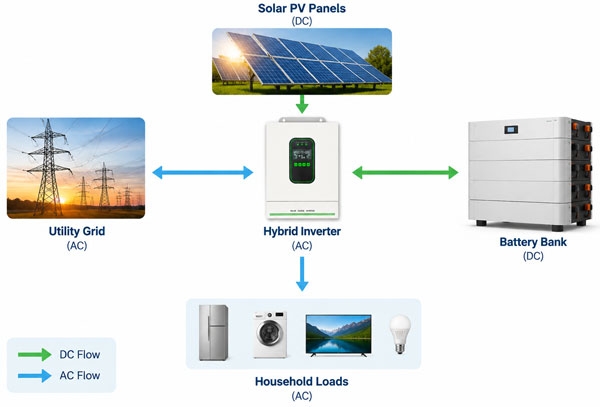
A hybrid inverter is an advanced power conversion device that combines solar energy conversion with battery storage management in one integrated system. It converts direct current (DC) electricity generated by solar panels into alternating current (AC) electricity for residential and commercial use, while managing energy flow between solar panels, batteries, electrical loads, and the utility grid.
How Does a Hybrid Inverter Work?
A hybrid inverter integrates photovoltaic (PV) power conversion, battery charging and discharging control, and energy management to coordinate electricity flow between solar panels, battery storage, electrical loads, and the utility grid.
- MPPT (Maximum Power Point Tracking): The inverter uses MPPT algorithms to continuously adjust the PV operating point, helping the solar array deliver optimal available power under changing irradiance and temperature conditions.
- DC-to-AC Power Conversion: Power semiconductor switches and high-frequency switching control convert DC power from the PV array or battery system into AC power for compatible electrical loads. The inverter regulates output voltage and frequency according to its operating mode and applicable electrical requirements.
- Battery Charging and Discharging Control: The inverter manages battery power according to battery voltage, state of charge (SOC), charge and discharge current limits, and battery management system (BMS) communication where supported. This helps maintain safe operation and coordinate energy storage with system demand.
- Intelligent Energy Management: An energy management system (EMS) or integrated control logic monitors PV generation, load demand, battery status, and grid conditions. Based on configured operating priorities, it determines whether available solar power should supply loads, charge the battery, or be exported to the grid where permitted.
- Grid Synchronization and Power Control: In grid-connected operation, the inverter synchronizes its AC output with the utility grid and controls active and, where supported, reactive power. Built-in protection functions help respond to abnormal voltage, frequency, and grid conditions in accordance with applicable requirements.
- Backup and Off-Grid Operation: Hybrid inverters equipped with backup functionality can establish or maintain a local AC supply for designated loads when the utility grid fails. This requires appropriate grid isolation, a compatible battery or other supported energy source, and an inverter designed for backup or grid-forming operation.
Through these coordinated power conversion and control functions, a hybrid inverter enables efficient solar energy utilization, flexible battery storage, and reliable integration with residential or commercial electrical systems.
What Are the Main Benefits of a Hybrid Inverter?
A hybrid inverter offers several advantages for solar power systems, especially when combined with battery storage.
- Improved Solar Energy Utilization: A hybrid inverter allows excess solar energy to be stored in a compatible battery instead of exporting all surplus electricity to the grid. The stored energy can then be used when solar production decreases, increasing solar self-consumption.
- Lower Electricity Bills: By using stored solar energy during periods of low solar production or higher electricity prices, users may reduce the amount of electricity purchased from the grid. Actual savings depend on local electricity rates, battery costs, energy consumption, and utility export policies.
- Backup Power During Grid Outages: Some hybrid inverters can provide backup power during grid outages when connected to a compatible battery and the required backup equipment. This helps keep essential appliances running, depending on the system's backup capacity and configuration.
- Greater Energy Independence: Combining solar panels with battery storage reduces dependence on grid electricity. Although complete energy independence is not guaranteed, a properly sized system can provide greater control over energy use and improve resilience during certain power disruptions.
- Flexible Battery Integration: Many hybrid inverters support compatible battery storage, allowing users to design a solar-plus-storage system around their energy needs. Battery voltage, communication protocols, and expansion limits should be checked before selecting equipment.
- Simplified Energy Management: A hybrid inverter integrates key power conversion and energy management functions into one device. Depending on the model, monitoring tools can help users track solar generation, battery status, household consumption, and grid power.
What Are the Main Application for Hybrid Inverter?
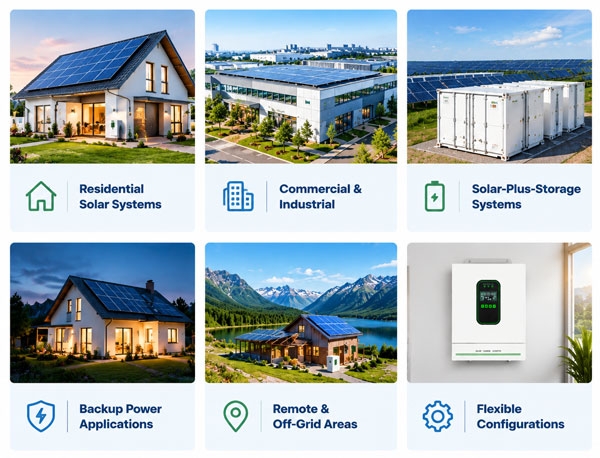
Hybrid inverters are widely used in residential, commercial, and off-grid solar power systems. They combine solar energy conversion and battery storage management to improve energy efficiency and power reliability.
- Residential Solar Systems: Help homeowners use solar energy, reduce electricity bills, and store excess power for later use.
- Commercial and Industrial Buildings: Help businesses optimize energy consumption and reduce grid electricity costs.
- Off-Grid Solar Systems: Provide electricity for remote homes, farms, and other locations without reliable grid access.
- Backup Power Systems: Supply electricity to essential appliances during power outages when compatible batteries and backup equipment are installed.
- Solar Energy Storage: Store excess solar energy for use at night or during periods of low solar generation.
Hybrid inverters offer a flexible solution for improving solar energy utilization, reducing grid dependence, and meeting different energy needs.
 FAQ
- What is the difference between a hybrid inverter and an off-grid inverter?
A hybrid inverter can work with solar panels, batteries, and the utility grid, while an off-grid inverter is designed primarily for systems without a grid connection. - How do I choose the right hybrid inverter size?
Choose a hybrid inverter based on your total power consumption, peak load, solar panel capacity, and battery requirements. Consider future energy needs when selecting the inverter size. - Which battery voltage is compatible with a hybrid inverter?
Battery compatibility depends on the inverter model. Some hybrid inverters support low-voltage batteries, such as 48V systems, while others require high-voltage batteries. Always check the manufacturer's specifications. - Can a hybrid inverter supply backup power during a grid outage?
Yes, if the hybrid inverter supports backup operation and is connected to a compatible battery with the required backup configuration. The available backup power depends on the inverter's rating and battery capacity.
Conclusion
Hybrid inverters offer flexible applications ranging from residential solar installations to commercial energy management and remote off-grid power systems. The right solution depends on electricity demand, grid availability, battery requirements, and backup power needs. Before choosing a hybrid inverter, evaluate its power rating, battery compatibility, operating modes, and support for the intended application.
(1).png)
Strong Power Supply, Smart Power Solutions.


